Posts

Showing posts with the label product experience management

Overcoming Today's Biggest Retail Inventory Management Challenges

Image
  It's safe to say that inventory is at the heart of the ever-evolving retail industry. For businesses worldwide, managing inventory to ensure a pleasant and seamless customer experience has become one of the primary focuses in today's highly competitive retail landscape. The inventory software market is growing rapidly and is expected to exceed   $3 billion by 2024 , with cloud-based software claiming over 30% of that market share. Data analytics, IoT, and Cloud Computing are now some of the most highly sought-after technologies in the supply chain sphere. Good inventory management practices can be a game changer when it comes to achieving exceeding customer expectations and maintaining healthy profitability. While comprehensive inventory control and accurate sales forecasts are reliable strategies, that's just the tip of the iceberg as far as inventory management is concerned. The challenges are as diverse as the global and local markets in which retail businesses operate...
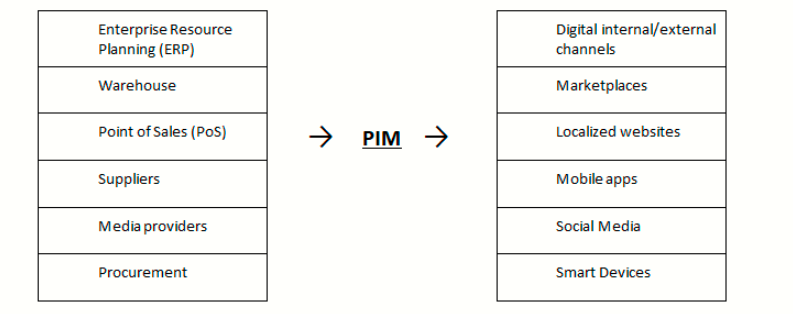
5 Reasons PIM and eCommerce Will Create Magic Together in 2021

Image
  It was clear that in the first quarter of 2020, driving a culture of data management would be critical for all online sales. Enter an unprecedented disruption and the dynamics change forever. The events of 2020 propelled digital commerce to new heights, ushering organizations towards digitalization and vendors towards new approaches and models. Going by   online holiday sales   in the US so far, digital selling is bound to reach historic levels. In 2021, over  2.14 billion buyers  are likely to buy online globally As the lines blur between physical and digital and selling becomes ubiquitous with consistent experiences across customer touchpoints, eCommerce merchants have realized the indispensability of Product Information Management (PIM). The need to store, structure, and visualize the right product information is increasing by the day – be it for campaign engagement, channel traffic control, catalog development, audience segmentation, or analytics. Moreover...

Predictions: 10 technology trends in marketing for 2020

Image
What difference will artificial intelligence and emerging technology make to marketing in 2020? CMO asks the experts Technology is changing faster than marketers can keep up, offering up an eternal land of promises. Increasingly, hard decisions need to be made regarding which technology to implement and whether it can be tied back to measurable marketing objectives and improvements. Technology for technology’s sake can wind up being a costly exercise with no discernible point. CMO spoke to the experts about which marketing technology will make the difference in 2020. 1.  AI for customer engagement Leading the list, of course, is artificial intelligence (AI). As the technology continues to evolve in leaps and bounds, so too does its applications in marketing. From next best action, to collating and providing deeper data insights, it seems AI will be the marketer’s right-hand tool for many years to come. In fact, we’ve barely touched the surface as yet. As  P...

Headless Commerce: A ‘Best of Both Worlds’ Approach for Manufacturers

Image
Customer Experience (CX) today is as important a differentiator for manufacturers as product quality and price. Interactions on any level of business impact customer perception and their decision to keep coming back or not. In these times, where digitization shapes how buyers think and what they expect, relying on just traditional stores or distributors to reach end-customers is no longer enough. Manufacturers need a way to deliver the same level of the personalized customer experience through online channels that customers receive in a physical store. With an elongated supply-chain full of multiple touchpoints, manufacturers are now becoming more interested in how customers make their purchase decisions and what influences them across their buying journey. Sometimes, they do not get enough in-depth data insight about consumer behavior as behavioral data mostly lies with distributors/retailers/middlemen or market places. Furthermore, with customers gettin...

What Is Product Experience Management (PxM) and Why Should It Matter to Your Business?

Image
To answer this, here’s a direct question: are your product content and digital assets optimized in line with your customer experience? In other words, do you think you’re doing well on the product experience front? Yes, no, maybe? Well, let’s dig a bit deeper. We hope you’re aware that your product data must endlessly deliver on the promises you’ve made to your customers, i.e., providing them engaging product experiences across channels. To achieve this, you need to deploy well-organized customer journeys for your products, which is only possible when a potent mix of product information management and product content management takes place. That’s because they’re essential to deliver, what’s come to be known as, product experience management or PxM. PxM comes along with capabilities like product content analysis, personalization, contextualization, automation, and optimization through machine learning (ML) and artificial intelligence (AI). As a step forward from product informati...